
This is part 2 of 4 in the series: Explain My Property Taxes. Topic is county taxes.

Super short story #
County property taxes work the same way that village property taxes work.
Read part 1 if you haven’t already.
Short story #
- County sets spending for new year
- General fund spending can only increase from prior year by percentage of net new construction
- Add the debt service payments to get total levy
- Divide total levy by total valuation to get tax rate
- Produce tax bills, where amount = your valuation * tax rate
Everything I wrote in the village explanation applies here as well. And the conclusion applies as well: the key is to control spending and debt.
Detour - Theory of Net New Construction Limit #
State legislature, being all-knowing, all-seeing, and undeniably benevolent, desired to constrain local property tax increases. They needed a proxy that was a good indicator of the amount of legitimate new spending. The illegitimate kind is when your local officials can’t say no to any request for more spending. If left unregulated, those local officials would just tax you to death and it can take years to change enough elected officials to make a difference.
So the omniscient and benevolent legislature, who by the way does not see fit to constrain themselves similarly, constrained local government general fund budget increases to this percentage:
\begin{equation} allowable\ increase = \frac{value\ of\ new\ construction}{total\ municipal\ valuation} \nonumber \end{equation}
County and village work exactly the same way. County is obviously just bigger numbers on both the numerator and denominator.
Crazy Detour from the Detour – Quantum Mechanics #
Yeah, really, trust me. Quantum mechanics.
New construction actually IS a decent proxy for general fund levy increase. New homes, new businesses, etc generally mean a community’s services costs need to rise. There are more police and fire calls, more roads to re-pave, more permits, more inspections, more open records requests, more paper clips, more, more, more.
There is a big problem though and it is absolutely best illustrated by quantum mechanics, which I don’t understand except for (barely) this article. It says that simply observing phenomena changes the results. Kinda weird, no?
Assuming you don’t understand quantum mechanics and that it’s way down on your priority list to learn, here is a simpler way to understand the problem: The Hawthorne Effect. A study was done to understand the impact of lighting changes on workplace productivity. Knowing that they were being watched and measured, workers were more productive during the study, but it had nothing to do with the lighting.
And another: “A study of hand-washing among medical staff found that when the staff knew they were being watched, compliance with hand-washing was 55% greater than when they were not being watched.”
Funny thing is human psychology. If you tell a bunch of municipal government officials that you are calculating allowable levy increases using a single variable, they are going to do more of that single variable because they know you are measuring it. Doesn’t matter if it’s construction, beers consumed, pullups, or 911 calls.
Back to the topic at hand #
State law pretends to have a purely independent variable – net new construction – that is a reasonable proxy for needed spending growth.
Reality delivers a number that becomes dependent – additional spending needed magically equals the allowable spending increase.
If the proxy were both reasonable and truly independent, it would approximate but not equal the actual spending every year. The odds of general fund spending increases equaling the exact amount of net new construction would be near zero. After all, we expect our elected officials to carefully determine minimum effective spending and set the levy to that number, right?
2026 Racine County Property Taxes #
Let’s look at Racine County’s 2026 property tax increase, which garnered some criticism from conservative state lawmakers. Article here. When I’m done here, you can judge for yourselves.
Remember, net new construction is just a proxy. It’s an independent variable, wink-wink.
Here’s what happened to spending levels in the county from 2025 to 2026:
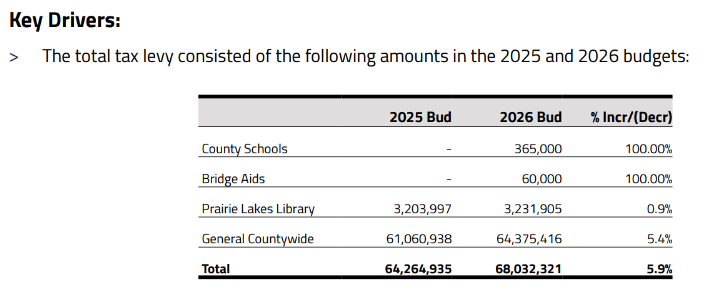
If I back out the debt line item and just compare the increase in the general fund, the increase is 4.83%. And just so you know, that increase is massive for a municipal government. Because of the levy limits from the state, municipalities and counties average 1.4% per year.
So now that the county has objectively set the bare minimum spending they need to effectively run the county, let’s check to see what the net new construction numbers allow them for the year. Independent variable, right?
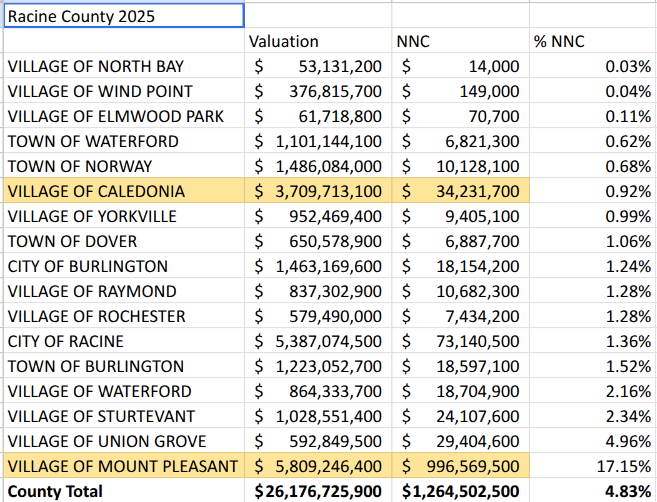
Well, would ya lookee there! Exactly 4.83%!! Sometimes it pays to be lucky!
Now let’s reveal how the county describes it, with my annotation.
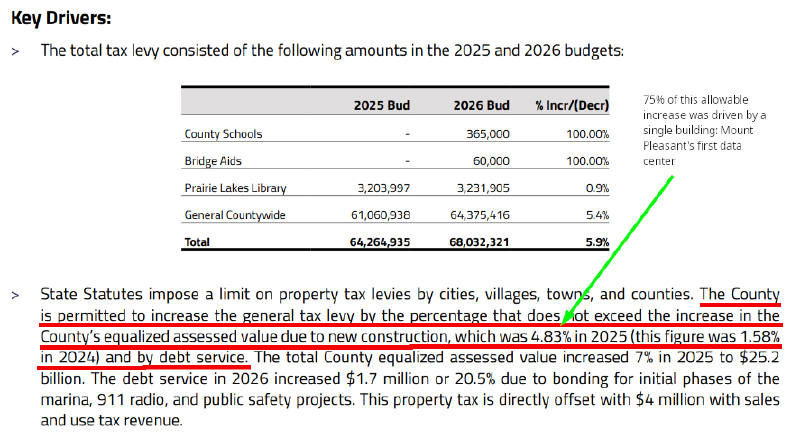
Their comments below the table that I underlined in red are the proverbial “quiet part out loud.” Translated, the comments mean: we can take this massive increase cuz state law says we can. And we know better what to do with your money than you do. It’s for your own damn good, peasants.
Quick review of the last few years’ budget documents indicate that this phenomenon of levy increase magically equalling allowable levy increase to the penny happens every year.
Original principles? You must be new here. #
Does a data center really drive $3.8M in new county expenses PER YEAR EVERY YEAR?
The original intent of the levy increase law was to constrain local governments from unreasonable increases in tax levies. You and I and the rest of the county taxpayers just got a $3.8M permanent increase in annual expenses because of a large building with very few employees and very little daily traffic in and out. And we got it despite having zero say into the project.
We do not have a county that is independently managing its spending levels, then making sure they fit into the allowable increase. They are “taxing to the max,” which is an actual term used in municipal government to describe the behavior. They calculate the maximum allowable levy, then fit the budget to it. And for the 2026 budget, they had an embarrassingly large allowable increase. And it’s always easy to spend other people’s money.
Did we really need a 4.83% increase. Would 4.79% have done? 4.5%? 3.5%? 2%? We had almost four times the usual increase and we needed the entire increase, to the darn penny. Right, got it.
And remember, because the data center is in a TID, all of the levy increase that it allows is paid for only by existing taxpayers. There’s no data center property tax payer to contribute their share.
And wanna hear the good news? Mount Pleasant approved an additional 15 data centers, all of which will hit the county’s tax rolls over the next 10-15 years. The tax-to-the-maxers at the county are giddy with excitement. As long as that Foxconn TID is open, you and I are not giddy with excitement.
If you want to know who loves data centers the most, it’s the counties, even if they are TID financed. The building valuations are delightfully large and justify healthy increases in total levy, but not so large that the common person is going to see what’s going on. Ozaukee County (for Port Washington) and Dodge County (for Beaver Dam) are going to see the same behavior soon. Mark my words.
This explanation makes it easier to understand the criticism we received from the county for running our Caledonia data center proposal out of town, doesn’t it? (Search for “County Executive” in that article.)
Now back to legislator criticisms #
If you didn’t read this article that I linked above, it includes criticism of the county spending increase by state legislators.
- “Crazy”
- “Bloated”
- “Out of control”
- “Financially irresponsible”
While I agree with that assessment, it is also true that the county is gaming the system that the legislature created and has shown no desire to improve. Desperate people do desperate things, and people respond to the incentives you create. I’ve yet to meet a local official who thinks the system based on net new construction works well, and I’ve met a lot of them while traveling around the state over the last year.
I love some good irony, and it’s quite ironic that the system put in place to constrain levy increases is actually causing outsized levy increases. Maybe it’s time to fix it.
Next up: Part 3, Community College