
The TID treadmill #
I admit my fascination with TIDs is getting unhealthy. Nonetheless, I can’t stop looking.
But first, a very short book review:
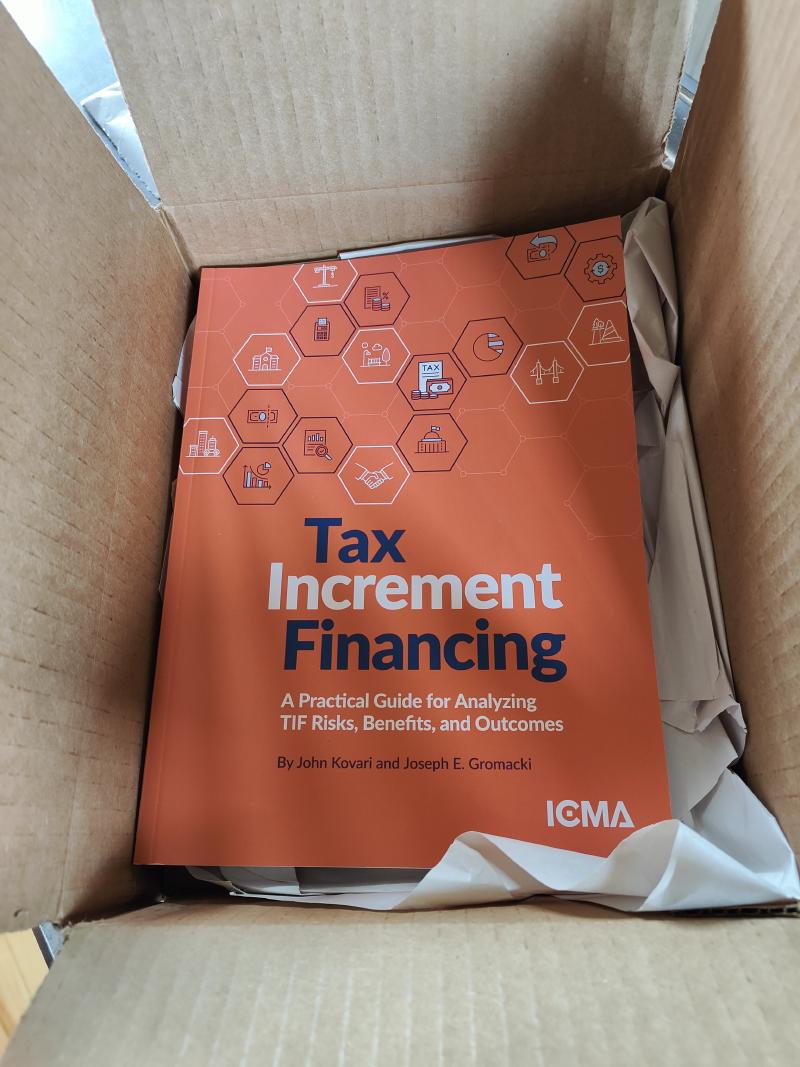
Beginning: good overview of what TIDs are, their history, why we have them
Middle: financial analysis necessary to keep developers honest and protect the village
End: best practices thought-starter
Conclusion: Don’t start doing them unless you are committed to doing them well. They are complex, you can be fooled easily, and they can go very badly. If you are using them to generate new construction so you can raise your levy, you’re doing them wrong.

It starts so innocently #
I’ve often wondered why some communities not only start doing TIDs but can’t seem to stop. Here’s maybe why. If you’ve been following my TID Talks(tm) through the campaign, you may already get all this, but stick around anyway.
Scenario: a community needs more total tax collection (aka the tax levy), but state law limits the increase to the amount of new construction. I.e. if you have new construction equal to 1% of your town’s total valuation, you get to increase the levy 1% and not a penny more.
- Community seeks moderate to large scale development
- Developers with money to build are limited
- Every community is calling the same limited number of developers
- Developers seek best deal
- Community says we’ll put you in a TID and reimburse some of your future taxes!
- Developer agrees, builds, and construction happens
Then we hit the fork in the road. This is the important part, so pay attention! Actually, it’s the sinister part, and you are the victim, so really pay attention.
Here it is in a flowchart:
 flowchart TD;
 A[Need More Levy]--> B[Create TID];
 B-->C[New Construction];
 C-->D[Raise Levy];
 D-->G[Increases Tax Bills on Current Residents];
 C-->E[Generates Tax Increment];
 E-->F[Tax Increment Refunded to Developer];
 F-->H[Year 2, same thing];
 G-->N[Year 2, still higher];
 N-->O[Year 3, still higher];
 H-->I[Year 3, same thing];
 I-->J[...];
 O-->P[...];
 J-->K[Year 20, last reimbursement];
 P-->Q[Year 20, still higher];
 K-->L[TID closes];
 L-->M[Tax bills return to baseline]
 Q-->R[Finally!];
 R-->M;
The construction “falls out” of the TID the year it happens. And by falls out I mean it gets included in the calculation for next year’s levy.
The tax payments of the developer who did the construction, however, stay in the TID. Those tax payments are called “increment” by the cool kids who do municipal financing. Being “stuck in the TID” means they pay for obligations in the TID, one of which is reimbursing the developer for their tax payments. I know, I know, such a deal. Can I haz some of dat tax reimbursement if I replace my roof?
So what? #
If you follow that flowchart, then you see that taxes go up while the TID is open, but then return to baseline when the tax payments finally fall out of the TID at year 20. Unfortunately, that means that current taxpayers pay 20 years worth of higher taxes because of the development in that TID…
…unless #
You have a few more TIDs active. If you have older TIDs that close at year 5, 10, and 15 of the sample TID in the flowchart, then the tax payments that finally come out of the older TIDs start contributing to the general fund and help ease the 20-year tax increase burden being caused by the newer TID.
And that is the TID treadmill. You start one to chase tax levy growth, then another to keep growing, and you need all of them to keep offsetting each other’s interim tax increases on current residents. Then you wake up one day and realize you’ve turned into Oak Creek.
[Btw, I found myself learning all this madness because of data centers in Port Washington and Beaver Dam that are financed via TID. Their massive scale exaggerates this problem and forced me to crawl into the rabbit hole.]
What’s the moral of the story? #
- Understand the tools you are using.
- Know what you are trying to achieve and how you will measure it.
- Then measure it.
- Then stop doing it if the math says you are failing.
If you understand TIDs, you should know that it is closing them that delivers benefit to residents. Some fun facts:
- Caledonia has never closed a TID.
- Our oldest TID, #1, was opened in 2007.
- Real estate valuation currently inside TIDs is $178M and the village’s total valuation is $3.7B. $178M / $3.7B = 4.8%.
- If we closed all our TIDs tomorrow, left our levy the same, just the village portion of everyone’s taxes would drop 4.8%.
- Village’s tax rate is 0.5% of assessed value
- On a $350K assessed value home, that would save you $84 per year
- At current forecast, TIDs will eventually produce double that benefit, but not until 2044 or so.
- Some of you are saying “really, that’s it?”
- Some of you are saying “cool, let’s do it.”
- FYI, we can’t close them until all obligations inside the TID are met.
- We’ve paid or committed to pay over $100M in developer incentives, and we we have a ways to go yet before those commitments are met.
- TIDs can produce indirect economic benefit depending on what development occurs within them.
- I don’t see a lot of effort, in our community or others around the state, trying to close TIDs. If anything, I see work to keep them open.
Burying the funnest of facts at the bottom to reward the readers who stuck with me to the end,
- Caledonia has averaged $37M per year in new construction over the past 8 years.
- Our total valuation is $3.7B.
- $37M is 1% of $3.7B.
If you are chasing new construction as a way to increase the tax levy, …
- 2.5% levy growth to offset 2.5% inflation requires construction of $93M
- $93M is 2.5x our yearly average construction of $37M
- In ten years, total valuation would grow to $4.6B
- …and 2.5% new construction becomes $116M
The treadmill gets faster under your feet every year.

Know the tool you are using. Know what you’re trying to accomplish. Be honest with yourself about whether you are achieving it, or whether you can ever achieve it.
Or… if your only tool is a hammer, then every problem is a nail.