
Time for the 4th of the 4 line items on your tax bill – school district property tax.
Some facts from tax bills #
- School district taxes are 43% of your 2025 property tax bill.
- School district taxes have risen 39% from 2014 to 2025.
- School district taxes have grown only 2.3% faster than inflation from 2014 to 2025 (I’m surprised it’s this low, but the data is the data.)
If you remember the big increase in tax bills two years ago, and think it was the referendum exclusively, you should read this article, but only after you’ve finished this and have some idea how it all works.
Ok, so how does it work? #
Recall the simplified process for village and county:
- Take last year’s budget
- Use state law to calculate how much more you can spend
- Calculate tax rate using total spending divided by total property value
- Calculate tax bills using property value times tax rate
School property tax calculation is sort of like that, except:
- State law governing school district increases is different
- And there’s this thing called equalization aid from the state that muddies the waters
So let’s go a step at a time…
How much more can we spend? #
There are two main justifications state law allows for increased spending: rising student count, and the infamous “400-year veto.” Well, ok, there’s referendum, too, which RUSD used a couple of years ago.
Do we have more students? #
The state uses a 3-year rolling average for “membership,” which is their goofy term for students. If number of students rises, spending can rise by some amount. If the number declines, spending gets pinched. Seems fair, no?
The hard part there is when there’s a persistent reduction in students, like say because of demographic changes happening now, or because results are poor and more people put their kids in private school. And now you understand why the schools don’t like vouchers. It pinches their spending if people pull their kids from the school district.
About that 400-year veto #
I’ll try to stay out of partisan politics on this one. A few years ago, our governor, using our state’s ridiculous character veto powers, turned this:
“For the limit for the 2023-24 school year and the 2024-25 school year, add $325 [per student]…”
…into this:
“For the limit for 2023-2425, add $325 [per student]…”
So the legislature wanted to authorize a 2-year $325 per student spending increase. The governor then used his red pen to delete numbers, hyphens, and characters to change the per year authorization from 2 school years to 402 school years. If you are a visual learner, here it is in black and red. The full text is what the legislature submitted. The red text is what the governor struck to create the resulting statute.
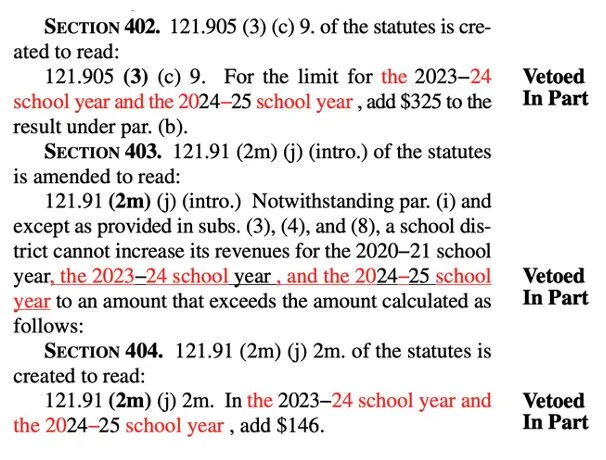
This “400-year veto” gets used for a lot of partisan bickering, but what is the real cost? RUSD spends $567M per year as of 2025/26. It has about 16K students. If you get to add $325 per student, that’s $5.2M more each year. That’s a 1% increase on their total spending, a 4% increase on their property tax levy.
Looking for that elusive middle-ground on an issue seemingly without any, I’ll say this:
- The governor changed the intent of the law from a one-time increase to a permanent increase with his character veto. That’s wrong, imho. Either strike the entire provision, or leave it as is. Governors shouldn’t write laws. I watched Schoolhouse Rock when I was a kid!
- It’s either a 1% or 4% increase depending on your perspective. That is greater than 0%, but my tax bill for the school district went up 20% last year. Maybe we could talk about why?
- No municipal government in the state, no matter the ideology of the people in charge, would turn down a mild, low single-digit inflation adjustment every year.
- It’s a bit of a stretch to blame our property tax increase on the governor’s cutesy trick.
- It’s also a bit of a stretch to claim the other guys are starving education when spending is rising while student count is dropping.
Fun little tidbit for your next cocktail party discussion:
The veto would have been struck down if the legislature had written out the years (e.g. “year two thousand twenty-five”). A constitutional amendment in 1990 prohibited striking individual letters to create new words. Striking numbers and hyphens to create new numbers apparently is still totally cool.
It’s the sort of case that makes you detest politics, but we should move on.
What’s this equalization aid thing? #
Even though the school system spends $567M, property tax is only $120M of that. Equalization aid is a bucket of money that the state allocates to school districts, and its goal is what its name implies: equalizing spending across the spectrum of rich and poor districts.
And the state determines rich vs poor using property tax per student. If everyone lives in mansions, you’re probably getting $0 in equalization aid, the theory being that your tax base can afford to fund the schools on property tax alone.
Back to process (quite a bit oversimplified, but it’ll do):
- Step 1: calculate allowable spending for new year.
- Step 2: state calculates equalization aid.
- Step 3: subtract equalization aid from spending to get the property tax levy
- Step 4: calculate tax rate (levy divided by equalized value)
- Step 5: calculate tax bills
Another fun, non-intuitive fact: if something big and expensive gets built in your community, like say a $1B data center, the equalization aid calculation will change dramatically. Your community will get less state aid. School spending doesn’t rise because construction isn’t a variable in the spending calculation. And your tax bill won’t drop either because the state takes a $1 reduction in state aid for every $1 of new tax revenue from the big new property.
And it doesn’t matter whether the new thing is big and expensive or small and cheap. Your tax bill doesn’t budge. The state aid chips in more if you get poorer relative to other communities, and the state lowers your aid if you get richer. You the property tax payer get nothing either way, almost like no one is looking out for you. Shocking, right?

Read this article if you really want to get into the explanation. The article uses a massive project as the example, but the math is the same for big or small.
Are TIDs a problem for the school district? #
Early on, I thought they were. “We’re tying up billions inside TIDs, robbing schools of funding!” Well, I’m man enough to admit I was mostly wrong on that one. I like being wrong on occasion. It means I’m learning something.
TIDs don’t rob a school district of funding. Trust me, it’s a long story, but I even met with the RUSD school superintendent and his CFO, and they confirmed that TIDs make no difference to them, or to your school property tax bill. It’s shocking until you understand the math.
The only way TIDs matter is as a whole across the state. If we closed them all and didn’t do any more, our school property taxes would drop. It would be fun to calculate by how much, but I need to stop adding more items to my to-do list. Plus, the odds of closing them all across the state and not doing any more are zero. The trains are powered by gravy, you know.

The moral of all four stories #
Whether it’s village, county, community college, or school district, it starts and ends with spending. Because spending other people’s money is super easy, the state applies limits. Sometimes those limits are too constraining. Sometimes they create unintended consequences. Other times they encourage really bad behavior.
After spending is determined, the rest of the process is mechanical – you pay your share of the total levy, where your share is your property’s value divided by the total of everyone’s property value.
Your tax bill’s line items never tell the whole story. If you want to find out who is looking out for you and who isn’t, you have to dig deeper.
A taxing authority can focus its efforts on vigorously reducing or eliminating expense, or it can focus its efforts on manipulating the variables used to increase its spending limits. For a village or county, the spending limit variable you always hear is new construction. For schools, it’s probably students.
Just my .02, but:
- The healthy taxing authorities focus on the spending. They do exist, but are sadly rare.
- The unhealthy ones focus on manipulating the variables that allow increased spending.
You can never ignore either one, but which one is the focus?