
I like to think I do pretty well on transparency. I ran a campaign with that as a central tenet. I publish agenda reviews and meeting recaps. I tell you everything you ever wanted to know and plenty you probably don’t care about. I want you to see how your local government works, not just the results it produces.
So imagine my frustration when this story unfolded:
The background #
- Everyone was complaining about the village website, because it deserves complaining about.
- Two major, inexcusably bad, transparency-killing, frustration-generating problems:
- The search function on the website is terrible.
- Most of the content on the website is in PDFs, and the website design hides them from Google and other search engines.
Our survey results showed that 50% of website visitors were unable to complete the task that drove them to the website. That would be a crisis in any private entity that relied on its website for business.
On the bright side, the site is really cheap.
There are plenty more problems, but let’s just start with those.
Example: search string “f street”
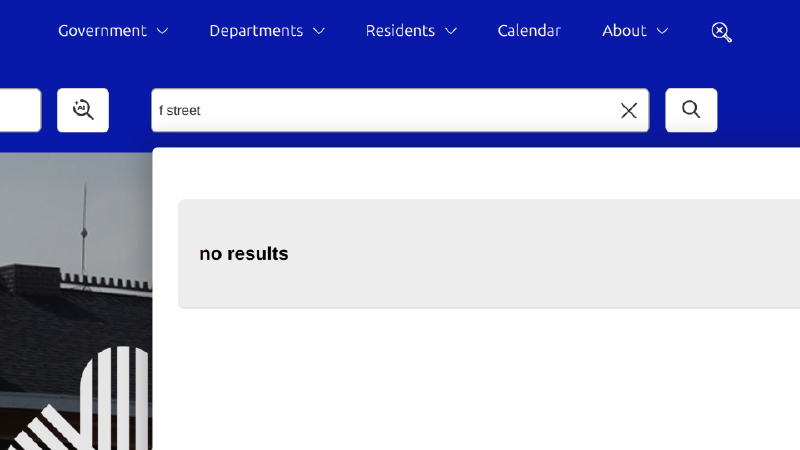
“F Street” is all over agendas this year. There should be multiple hits.
Let’s see if Google can find anything.
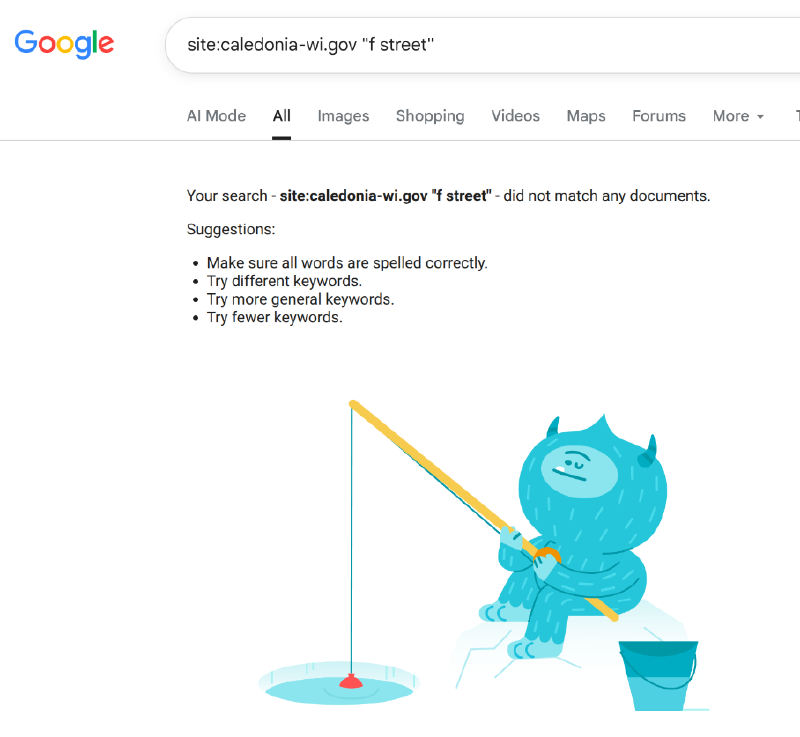
On a scale from 1 to 10, the combination of those two search failures gets a 0 for transparency. We are invisible to Internet search engines and our site’s search function doesn’t work.
We Need a Committee! #
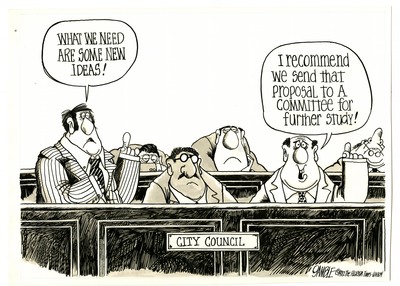
Of course we do. So we got some volunteers and a couple of trustees, and began meeting to discuss. The drill was simple: gather some opinions, talk to people who use it (staff, trustees, residents), look around at other sites, talk to the vendor, then make recommendations to the board for anything that will cost more than $1.99.
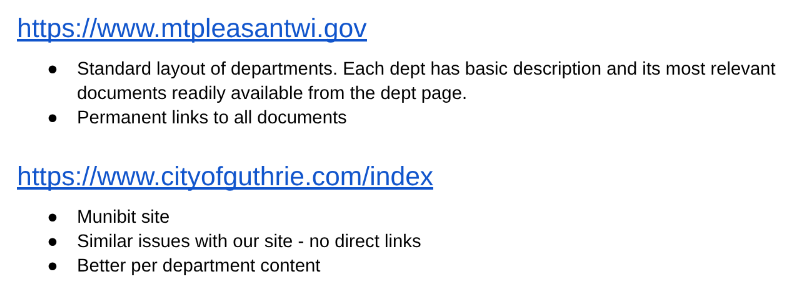
Then we did what every red-blooded group of people in 2026 does: we used an online tool (Google Docs) to keep feedback in a central document. As all know, those online doc tools keep detailed history of who edited the file and when. If anyone were interested to know which knucklehead on the committee had the audacity to think that the City of Guthrie, Oklahoma had an equally terrible website, they could quickly determine from document history that it was me.
Because it was a formally constituted committee by the board, we were required to toe the line on open meetings laws. I’d link you to one of our formally published agendas, but our website doesn’t do that. You can find it with a search, so apparently our website randomly decides which text strings to find.
That formality requires public notice of meetings, published agendas, sticking to published agenda topics in meetings, keeping the conference room door open when we meet, allowing public comment, publishing minutes, and so on.
Irony, with a dash of absurdity, topped with farce #
After several meetings and nearly completed documents, I got a call saying we couldn’t use Google Docs to capture our notes. Instead, we had to use the process below if we wanted the committee to have a central document of notes:
- Each committee member keeps their own notes
- Each member would email their notes to the clerk at least 2 days prior to the meeting
- The clerk would include the notes in the meeting packet
- The meeting agenda would include discussion where we would agree to aggregate the notes
- The clerk would aggregate the notes after the meeting
- The aggregated notes would be published in the next meeting for committee review
Because transparency or some such. The local government with a failing score on transparent website access to its information was applying the letter of the open meetings law to innocuous note-taking by a group of volunteers trying to make information more accessible to the public. Irony, with a dash of absurdity, topped with farce.

Yeah, no #
If I was unable to find multiple examples of interpretations of ordinance and statute that conveniently allowed the village to do things it wanted to do, maybe I would have been less irritated. So after some debate, agreeing to disagree, and realizing we should never have formally constituted the group in the first place, we just decided to stop taking notes and move to the recommendation phase. And I apologized to the citizen volunteers.
Funny, not funny #
So, yes, it’s a story equally funny and maddening, but does it matter? Yes, I think it does.
Were you one of those kids that asked ‘Why?’ a million times? I was. Why do we have open meetings laws? It’s simple. Quoting from the statute, “the public is entitled to the fullest and most complete information regarding the affairs of government as is compatible with the conduct of governmental business.”
Then, later in the Definitions section of that statute, clarifying when a body needs to be formal:
“Rather, an entity must exist that has the power to take collective action that the members could not take individually.”
We even wrote the charter of the group to preclude the group from directing staff to do anything with any cost to it. A random group of residents could do what we were doing and present their findings to the village board when done. No formality needed.
There’s no doubt that in our response to this innocuous instance of gathering website opinions and research that we discouraged public engagement, limited information gathering and publication, and reduced transparency of the group.
When you find that your interpretation of the law coupled with its application to a certain instance causes the opposite of that law’s intention, you should question either your interpretation or your decision to apply the law to that instance.
I could go on, but I’m out of humorous images to share on the topic.
Wait, one more thing. The real transparency test is what you do when the law doesn’t require transparency but the situation demands it. Remember that big proposal last August? You know, the one that started this wild ride.