
Now it all makes sense #
In fall of 2025, after Caledonia’s data center proposal was withdrawn, I started looking at data center proposals in Beaver Dam and Port Washington. I was dumbfounded by how bad the deals looked. And into the rabbit hole I went… TIDs here there and everywhere, state statute, levy calculations, municipal government, and more. I wanted to understand how reasonably intelligent people could unanimously agree to something so bad. These deals were catastrophically bad at the scale of a hyperscale data center in a small town. They were just normally bad at their usual scale. Taxpayers were getting the shaft in both cases. I wanted to understand why.
After much research, I think I understand why, and I think the story is quite simple. Join me for a brief tour of the rabbit hole. Really, honestly, I promise to be brief, or at least as brief as I can be.

Step 1 #
State passes law that says you can only raise the levy by the amount of net new construction you had the prior year. Numerator is dollar amount of new construction. Denominator is total property valuation in the village.
If you want to exceed that number, you have to go to referendum. You risk getting told NO! by the residents if you go this route. Naturally, you focus on the construction number. Here are Caledonia’s numbers by year.
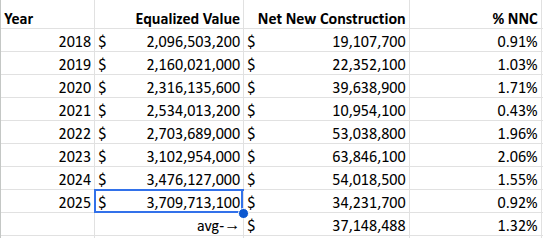
Note that as the denominator (total valuation) gets bigger, it gets harder to grow.
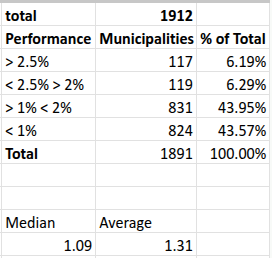
Also, never judge a number in isolation. How are the rest of Wisconsin communities doing on growth? 43% are between 1% and 2%. 43% are below 1%. So it’s safe to call our performance average. The median value (half of communities are above, half are below) is 1.09% growth.
Here is the distribution of growth rates for all 1912 municipalities in 2025:
Step 2 #
Fact: humans have free will
If you tell me that to get what I want (more levy) I need X, then I will actively pursue more X, whether it’s beer, miles driven, police officers hired, or new construction. We love single-variable problems.
To prove my point, we should do an experiment. Change the law to “You can raise the levy equal to the increase in total number of beers the trustees drink in a year.” Do you think the amount of beer consumed by trustees would go up, down, or stay the same? (Scroll to the bottom for the best solution.)
Step 3 #
Now for a lesson in basic economics. Construction labor and capital (the money to build) are finite in supply. Demand just shot through the roof because of the state law.
What happens when demand increases and supply stays the same? PRICE GOES UP. Every time.
Step 4 #
Unless you are a terrible businessperson, when someone dramatically increases demand for your services, you are going to shop your services around for the highest price.
But how does a local government pay for development? Tax breaks. And you can only give out tax breaks via TID.
And TID tax breaks are especially robust because they allow the municipality to give away future tax revenue for all four taxing authorities: the village, county, school district, and community college. Another topic for another day: why do those other taxing authorities keep saying yes to these TIDs? 20 years is a long time to wait for the new tax revenue.
So the tax breaks start flowing…
Step 5 #
Increasingly desperate to land a deal thanks to inflation, and unable to differentiate themselves except on price, the price goes to the max. Our own TID 6, for example, gave 95% tax reimbursements to the developer to build 250ish homes east of Douglas Ave. Add a little TID administrative cost, and there isn’t much left there for the village to use on any Douglas Ave beautification projects that were proposed in the TID.
And back to how I got into this rabbit hole… increasingly desperate to land a deal that builds something, anything, communities like Port Washington give hundreds of millions in tax breaks to big tech companies so that they generate massive amounts of construction in their town. They looked at that construction number and said “THIS SOLVES ALL OUR PROBLEMS FOREVER! ANY PRICE IS FINE!” They were horribly, horribly wrong, but that’s a story here, here, here, and here unto itself.
And that is how local officials say yes to really bad deals. They are simply scared they can’t pay the bills and they’ve been given one tool that looks like it solves the problem, side effects and actual results be damned. Everybody’s doing it. It must be the right thing. Homework is hard and time-consuming. We’ll just do what everyone else is doing.
Side effects #
In 2022, State Senator Duey Stroebel asked the non-partisan Wisconsin Legislative Council the simple question:
Do TIDs increase property tax bills?
The commitment to the tool is so deep, though, that when some knucklehead starts posting about the raw deal on social media, the justifications start rolling in…
- If it weren’t for the tax breaks, the revenue from the property would be zero, so it’s ok.
- It’s the way the game is played. Either we play or enter a fiscal death spiral.
- If we don’t subsidize the development with tax breaks, the development will be poor quality.
- We can’t take the chance with a referendum to raise the levy. People might say no.
It’s hard to appreciate how deeply committed to the game everyone is until you start questioning it.
Final .02 #
State law is well-intentioned but poorly designed. It creates terrible incentives and desperation, especially in periods of high inflation. And local governments are playing this game of chess one move at a time. By move 6, they are nowhere near where they wanted to be and are sometimes even checkmated.
I don’t have easy answers to the problem, but remember my campaign line? “Doing things for you, not to you.” Well, this scheme does something to you. Honest, transparent presentation of what is going on is the best first step to finding our way to our community’s answer to the problem. Over time the levy will need to rise to offset the increase in costs outside of our control. The easiest thing to do is play the game and keep quiet about it. I can’t support that approach. I can support an approach that shows with numbers what we are trying to do and whose success is measurable when done. I can also insist that if we are going to provide someone reimbursement of future tax payments that the residents get something in return.
I am absolutely not suggesting we stick our heads in the sand or just whine about state law.
Best solution to the beer question #
- Elect 6 people who don’t drink.
- Elect 1 who drinks only 1 beer per year.
- Force the 6 to each drink 1 beer the following year.
- Force the 7th to drink 2 beers.
- Net New Beer Drinking (NNBD) is 7/1 = max allowable levy increase of 700%.
Note that is important that you have 1 trustee who drinks 1 beer in the first year. I don’t know how state law would deal with a denominator of 0 in the calculation.